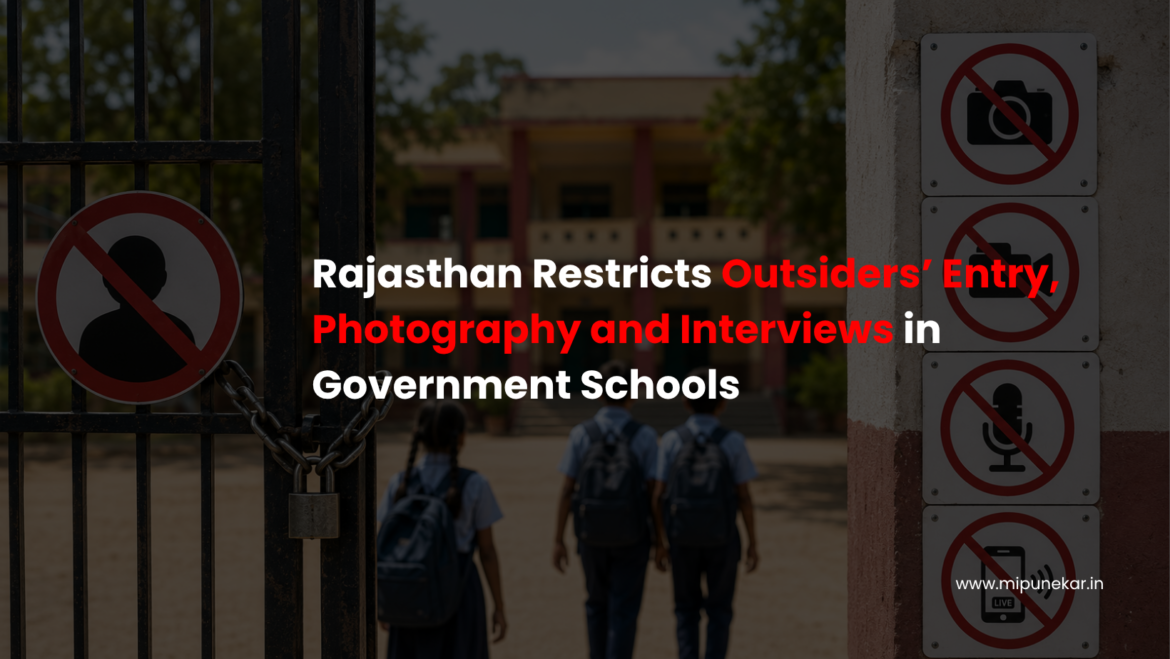
The Rajasthan government has imposed new restrictions on outsiders entering government schools, as well as on photography, videography, interviews and live streaming on school premises.
According to a circular issued by the Secondary Education Department on 17 August 2026, outsiders will not be permitted to enter government school premises without prior permission from the school principal. Even when entry is allowed, visitors must be accompanied by authorised school staff.
The new guidelines also require written permission for photography, videography, interviews and live streaming within school premises. The restrictions apply to areas used by students, including classrooms, hostels, libraries and toilets.
The government said the measures are intended to protect the privacy, dignity and safety of students. School authorities have also been instructed to prevent the publication or circulation of students’ photographs, videos or personal information in a manner that could compromise their privacy or safety.
The directive comes at a time when Rajasthan’s government schools have come under increased public scrutiny over their infrastructure and facilities. The timing of the circular has also drawn attention because it coincides with the Cockroach Janta Party (CJP) announcing its statewide “School Thik Karo” campaign, under which the party plans to visit and assess government schools.
The campaign has focused attention on the condition of school infrastructure and facilities across the state. The new restrictions have therefore sparked discussion over the balance between protecting children’s privacy and allowing public scrutiny of government institutions.
The Rajasthan government has cited the principle of “in loco parentis”, under which the state assumes responsibilities similar to those of parents when children are under its care. The order also refers to Article 21 of the Constitution, Supreme Court judgments concerning the right to privacy, and guidelines issued by the National Commission for Protection of Child Rights (NCPCR).
Under the new framework, school authorities will be responsible for ensuring that unauthorised individuals do not access school premises and that student-related photographs or personal information are not shared inappropriately.
The restrictions are expected to have a direct impact on individuals, organisations and groups seeking to document conditions inside government schools. At the same time, the government maintains that the primary objective is to ensure that children’s privacy and safety are not compromised.
The development comes amid continuing debate over transparency, accountability and the condition of government schools in Rajasthan.